
The pattern of your shaking when it happens, which side, and what makes it better usually points to the answer. A Free ten-minute check to work out which pattern is yours.


Most people who notice a tremor are worried about one thing. The good news is that the most common cause of shaking is not Parkinson’s disease — it is essential tremor, which is far more common and much less serious.
Telling them apart comes down to when the shaking happens. The check asks the questions a neurologist would ask, in the same order.
Sudden, wild, flinging movements of the arm and leg on one side of the body are not a tremor. This is called hemiballismus and it usually means something has happened in the brain, often a small stroke.
Source: NICE NG128 (acute focal neurological deficit) · NHS FAST stroke pathway
Do it now. Every minute makes a difference.
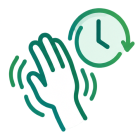
Essential tremor. Shows up when you are using your hands — holding a cup, writing, doing up buttons, holding a spoon steady. It is usually on both sides, and roughly the same on each. Your hands are still when they are resting in your lap. It often runs in families.
Parkinson’s disease. Shows up when your hand is resting and doing nothing, often with the thumb and fingers rubbing together. It usually starts on one side only. It tends to fade when you reach out to pick something up. It comes with slowness and stiffness rather than appearing on its own.
This matters because the treatments are completely different, and so are the tests.
Source: NICE NG71 (Parkinson’s disease in adults)

A tremor that briefly improves after a small alcoholic drink points strongly towards essential tremor. It is a genuinely useful piece of information, and worth mentioning even though it feels like an odd thing to tell a doctor.
It is a diagnostic clue, not a treatment. Using alcohol to control a tremor causes worse problems than the tremor.
NICE recommends propranolol or primidone as the first medicines to try for essential tremor. Which one, and at what dose, is a decision for the consultant who assesses you.
Source: NICE NG71 — propranolol and primidone as first-line for essential tremor

This is called drug-induced parkinsonism, and it is missed often. The tremor, stiffness and slowness can be impossible to tell apart from real Parkinson’s disease at the bedside.
The usual culprits in the UK are:
metoclopramide (Maxolon), for sickness
prochlorperazine (Stemetil), for dizziness and sickness
antipsychotic medicines
sodium valproate
The important difference is that it can get better once the medicine is stopped. That is why the check asks about your medicines before it asks anything else.
Do not stop a prescribed medicine on your own. It needs to be done with your prescriber.
Source: MHRA Drug Safety Update · BNF · NICE NG71

A DaTscan is a scan that looks at the dopamine system in the brain. It is used when it is not clear whether someone has Parkinson’s disease or essential tremor.
If you are taking metoclopramide, prochlorperazine or an antipsychotic, the scan can give a misleading result. The medicine normally needs to be stopped, and your symptoms given time to settle, before the scan is worth doing.
The check flags this automatically so that you are not sent for a scan that cannot answer the question.
Source: NICE NG71 — DaTscan where there is diagnostic uncertainty
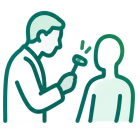
The UPDRS is the standard examination for Parkinson’s disease. The neurologist watches you walk, tests the stiffness in your arms by moving them, checks how quickly you can tap your fingers, and gently pulls you backwards to test your balance.
None of that can be done over a video call. Anyone whose answers suggest a resting tremor is routed to a face-to-face appointment.
Source: NICE NG71 — UPDRS motor examination

If a movement disorder affects your ability to control a vehicle safely, you must tell the DVLA. This applies to Parkinson’s disease and to a severe tremor.
Telling them is your responsibility, not ours. Your consultant will advise you on where you stand.
Source: DVLA Assessing fitness to drive (GOV.UK)
We ask about mood, memory, motor skills, and sensory changes to tailor your diagnosis and treatment.

If nothing urgent is found, Select a package Bronze, Silver and Gold options
From
£123
From
£345
From
£567
Start at
£349
Start at
£695
Video appointments start at £349. In-person appointments, which include the full UPDRS examination, start at £695. DaTscan is available in Silver and Gold where there is genuine uncertainty.